
How Often Should You Service Your Dental Handpieces?
Article Summary
Regular handpiece servicing isn’t optional — it’s essential for precision, longevity, and patient comfort. Learn how often to service your high-speed and low-speed tools, what signs to watch for, and how The Handpiece Guy LLC helps Charlotte dentists prevent downtime with on-site, same-day maintenance and OEM-quality repairs.
A Practical Guide for Keeping Your Tools Reliable, Efficient, and Patient-Ready
Every dentist knows the feeling — that subtle vibration, that faint change in pitch, or that telltale heat radiating from a high-speed handpiece that used to glide effortlessly. It’s a small sign, but it speaks volumes: your handpiece is overdue for service.
Handpieces are the workhorses of every operatory. They perform under heat, pressure, and moisture thousands of times per week. Yet, despite being one of the most used instruments in dentistry, they’re often the least maintained — until they fail mid-procedure.
At The Handpiece Guy LLC, we’ve seen how inconsistent maintenance leads to premature wear, noisy operation, and unnecessary downtime. The truth is, regular service isn’t optional — it’s what keeps your practice running smoothly and your patients comfortable.
Think of your handpiece like a high-performance engine — it runs best when it’s clean, lubricated, and calibrated. Every internal component (bearings, turbines, O-rings, chucks) is moving at speeds up to 400,000 RPM, and even microscopic debris or dried lubricant can cause friction, imbalance, or loss of power.
When maintenance is skipped or delayed, several issues compound over time:
- Bearing fatigue from micro-vibration during sterilization cycles
- Loss of torque due to lubricant breakdown and residue buildup
- Chuck wear leading to bur slippage or “runout”
- Increased heat output affecting both tool and patient comfort
Regular servicing prevents these problems before they compromise performance
Recommended Service Intervals for Handpieces
Every manufacturer varies slightly, but here’s a practical schedule we recommend for most dental offices in daily operation:
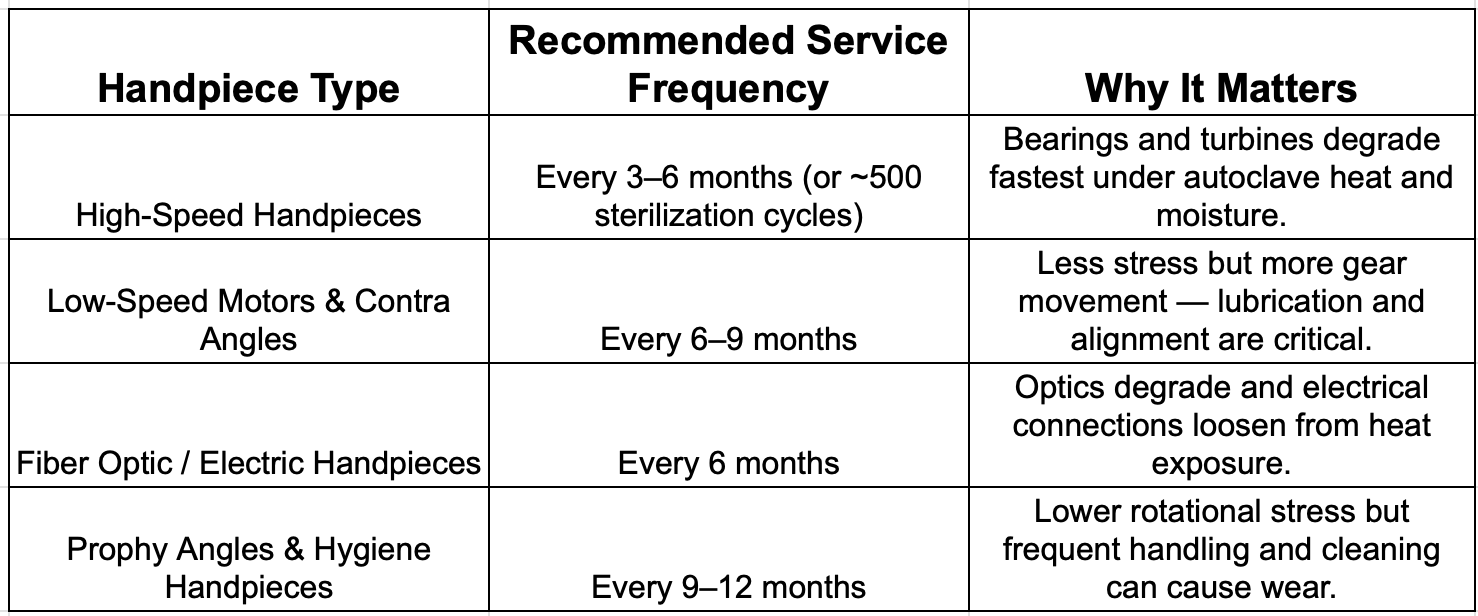
*Table is a summary of manufacturer recommendations; look at
ProdentUSA
for more details
For high-volume clinics or multi-chair offices, these intervals should be shortened. A handpiece that runs 10–15 times per day simply ages faster than one used occasionally.
While intervals are useful, your handpiece often tells you when it needs attention. Watch (and listen) for these early signs:
- Noticeable noise increase or “whining” sound
- Loss of cutting efficiency or reduced torque
- The handpiece feels warmer during use
- Burs slipping or “walking out” during prep
- Air/water spray not functioning properly
If any of these appear, don’t wait until the next scheduled maintenance. A quick inspection can prevent a full rebuild.
Learn more about our High-Speed Handpiece Repair Services and how we restore performance in 1–2 hours.
STILL CURIOUS ABOUT HANDPIECE REPAIR?








Frequently Asked Questions
Got questions about our dental handpiece repair services? Here are some common inquiries we receive from our clients.
How long does a repair take?
Most repairs are completed on-site within 1–2 hours, ensuring minimal downtime for your practice.
What types of handpieces do you repair?
We specialize in repairing a wide range of dental handpieces, including high-speed, low-speed, and surgical models.Do you use OEM parts?
Yes, we only use high-grade OEM-quality parts for all repairs, ensuring reliability and performance.Is there a warranty on repairs?
Absolutely! Qualifying repairs come with a 6-month warranty so you can have piece of mind
Can you repair handpieces on-site?
Yes, we offer same-day, on-site repairs to get your handpieces back in working order quickly.
What if my handpiece cannot be fixed?
If your handpiece is unique, we will order the specialized product, fix your handpiece, and call you as soon as it is done for delivery
If you have other specific questions, we are happy to drive to your location and give you our professional opinion.
Need more help?
If you have any other questions or need assistance, feel free to reach out to us directly.